

Tears of a Diaspora
For many Venezuelans, presidential elections are not just a political milestone; they are a visceral reminder of every life, home, and ambition left behind. To live in exile is to carry the invisible weight of interrupted paths, abandoned lecture halls, family tables left empty, and dreams suspended by economic collapse and forced migration.

A tear rolls down his cheek as he looks up, capturing the moment amid chants and waving flags. The pain and hope of a nation yearning for freedom are palpable in every expression.

A woman wearing the Venezuelan flag cap clasps her hands on her chest, her voice merging with the chorus of a crowd draped in flags.

A tearful mother holds her daughter tightly, wearing a cap adorned with the Venezuelan flag.
Nervin José stands as a living testament to this stolen time. With eyes clouded by tears, he speaks of a longing that goes beyond nostalgia: the desire to reclaim his identity as a surgeon. "Since I was 13, I dreamed of medicine," he shares, recalling how he fought through the first year of his degree in Venezuela before the crisis made the impossible a reality.

A crowd sings with their eyes closed, while a woman stands among them, wearing a shirt featuring a heart made from the Venezuelan flag with the word “Venezuela” beneath it.

Two men embrace, one wearing a cap emblazoned with “Venezuela” in the colours of the national flag.
Forced to migrate to Colombia, he watched from a distance as his former classmates graduated, a milestone that remains his greatest sorrow. Yet, his grief is anchored by a fierce, spiritual defiance. “I had to give up on my dreams for now, but with God’s favor, I will fight to make them a reality. I am certain we will break free from this dictatorship; I have faith that everything will change.”

Tears streaming down his face, a man carries his child while gazing ahead.

A woman cries, a tear rolling down her cheek as she clutches a small Venezuelan flag in one hand. Beside her, two men stand, one wearing a long-sleeve shirt that reads “Venezuela,” and the other one draped in the flag.
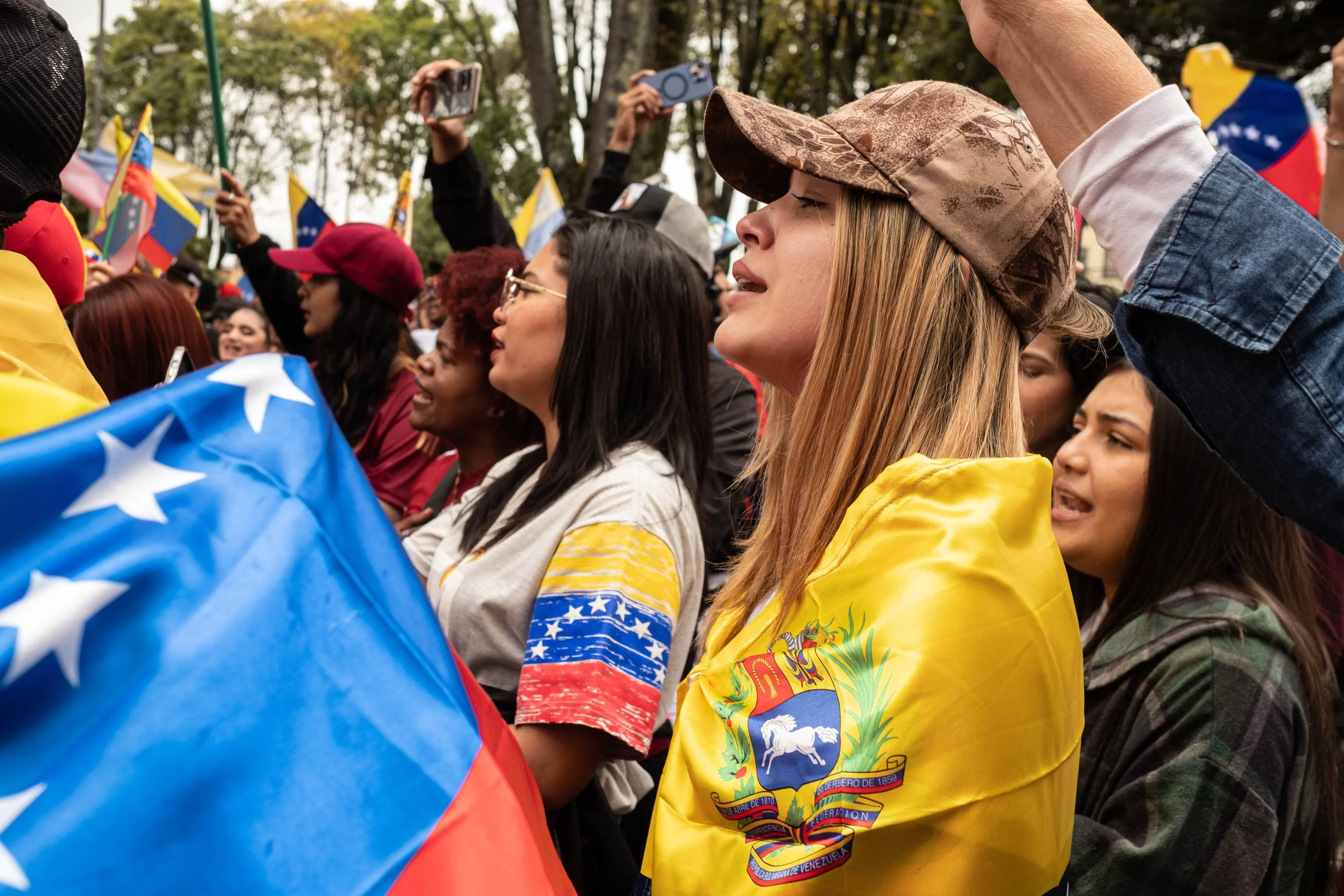
Wrapped in the Venezuelan flag, a woman cries and chants with deep emotion.
Nervin’s story is echoed in the faces of thousands who gathered in Bogotá, each one a bearer of a similar sacrifice. Their shared weeping during the mobilization was a powerful act of solidarity, transforming individual loss into a communal demand for justice.

Nelvin José, chants and cries, his tear-filled eyes closed, bathed in the golden light of the setting sun.
These photographs document that unique intersection of love and pain, where the hope of seeing a free Venezuela is the only force strong enough to mend the broken paths of those living in exile.